
US Vice President J D Vance and his wife Usha arrived in Delhi on Monday for a four-day visit. They were welcomed by Union Minister Ashwini Vaishnaw. Vance's visit comes amid ongoing trade talks between India and the US. Prime Minister Narendra Modi will host a dinner for the Vances on Monday evening after holding talks with the US Vice President. Vance and his family will also travel to Jaipur and Agra during their trip.

'If Washington has to balance Chinese power, she will have to turn to the third biggest power in the world which is India.' 'The United States and India will have to work together in order to keep Chinese ambitions in check.'
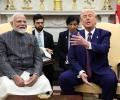
'Trump administration wanted a positive tone at this summit, but there was still some anxiety that there could be some awkward moments -- and there were not.'
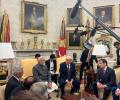
'Trump is not shy when he is frustrated with countries'

'You are a guest in the US. It's not your home, you're a guest. If they don't feel comfortable, you have to step out.'
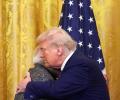
'He needs to see results while he is in office.'

Indian policymakers must realise that in buying small quantities of equipment, it becomes hard to start manufacturing them in India, explains Ajai Shukla.
Who accompanied Prime Minister Narendra D Modi to his Thursday meeting with US President Donald J Trump in the Oval Office, and who did POTUS bring along?
'Pakistan is no longer a front-burner issue for America.'
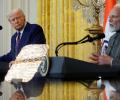
'But I don't think the government is in a great hurry to sign the BTA.'
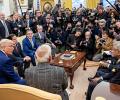
During the talks, India and the US decided to take a big leap in broad-basing their strategic ties in several critical areas.

India and the United States settled a dispute on Thursday that had paralysed the World Trade Organization and risked derailing a $1 trillion package of reforms.
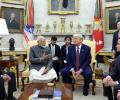
India and the United States have agreed to deepen their strategic partnership in several key areas, with President Donald Trump announcing plans to provide India with F-35 fighter jets and billions of dollars in military supplies. The two leaders also discussed energy cooperation, critical technologies, connectivity, and countering terrorism. They agreed to work together on the India-Middle East-Europe Economic Corridor, and Trump noted India's reforms to welcome US nuclear technologies. Prime Minister Modi said the two countries can shape a better world through their cooperation. Both leaders also addressed the Russia-Ukraine conflict, with Modi stressing India's commitment to peace.
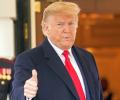
"I'm going to India next week and we're talking trade. They've been hitting us very hard for many, many years," Trump said at a 'Keep America Great' rally in Colorado on Thursday. Trump told thousands of his supporters that he "really likes" Prime Minister Modi and they would be talking business.
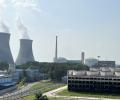
Government sources said amendments were being considered to the Atomic Energy Act to allow private sector participation and the Civil Liability for Nuclear Damage Act to limit the liability on suppliers of equipment to build atomic energy plants.
'By his words, actions, and body language during their joint press appearance wanted to convey his personal respect and, more broadly, his desire to work closely with India.'
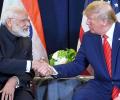
It would be the prime minister's first bilateral visit to the US after Trump became president for a second term.
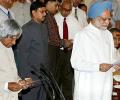
The landmark India-US civil nuclear deal of 2008, brokered during Manmohan Singh's tenure as Prime Minister, is seen as a crowning achievement in his foreign policy legacy. The agreement ended India's nuclear isolation, fostered a strategic partnership with the US, and opened doors to advanced technologies and defense cooperation. This historic deal also laid the groundwork for India's engagement with the global nuclear community.
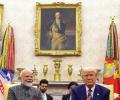
'Modi's intention was to create goodwill that will allow India to be seen by Trump as more than just a bad tariff problem.' 'He succeeded brilliantly on that count but none of these wins are unfortunately permanent.' 'Modi will have to do this again and again if Trump's grievances are to be durably assuaged.'
'When you think back to the promises made 10 years ago, not a single one of those had panned out to date.'
Richard Verma, the highest-ranking Indian-American official in the State Department, has expressed optimism about the future of US-India ties and emphasized the need to base the relationship on shared values rather than mere transactional dealings. Verma, who previously served as America's Ambassador to India, stressed the importance of the Quad in defending the international order, highlighting its shared commitment to a free and open Indo-Pacific.
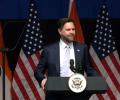
US Vice President JD Vance called on India to drop non-tariff barriers, give greater access to its markets and buy more American energy products and military hardware. Vance, in a speech in Jaipur, highlighted the need for a stronger US-India partnership for a prosperous and peaceful 21st century. He emphasized the importance of working together to address global challenges and praised Prime Minister Narendra Modi, describing him as a "special person." Vance also urged India to provide greater market access to American products and buy more defense platforms and energy from the US. He suggested that India consider dropping some of the non-tariff barriers for American access to the Indian market and highlighted the benefits of closer India-US defense collaboration, advocating for New Delhi to procure more military hardware from the US. He cited the example of American fifth-generation F-35s, arguing they would give the Indian Air Force the ability to defend its airspace and protect its people like never before. Vance also welcomed the Modi government's budget announcement to amend India's civil nuclear liability laws, paving the way for US producers to export small modular reactors and build larger US-designed reactors in India. He emphasized the importance of energy security for India's AI ambitions, stating "there is no AI future without energy security and energy dominance." Vance's visit comes amid growing global concerns over the US's tariff war.

'A less tense US-China relationship would make Beijing less likely to provoke India -- including on the border -- in retaliation for its close defence ties with the US.'
'The strategic direction of the relationship will not be affected. But the perception has been affected.'
India on Saturday announced plans to amend its nuclear liability law and set up a nuclear energy mission, a move that came ahead of Prime Minister Narendra Modi's likely visit to the United States.
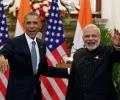
'At a time when the entire India-US relationship needs to be defined by President Trump and Prime Minister Modi, a fresh look at the liability issue has become urgent,' says Ambassador T P Sreenivasan, former Governor for India at the IAEA.

India, the US and 12 other members of the IPEF grouping have signed a supply chain resilience agreement that would help mitigate risks of economic disruptions from supply chain shocks and improve crisis coordination. The agreement would help member countries like India to reduce their dependence on China and provide timely information to the IPEF member countries about potential supply disruptions. The COVID outbreak severely disrupted the global supply chain, as most countries were dependent on China for various products like pharma raw materials.

India and the US on Monday committed to further improving bilateral ties, exploring alternate mechanisms for funding renewable energy and actively pursuing the G20 agenda which includes strengthening MDBs and taking coordinated action to deal with climate change. Several issues, including climate action, rising indebtedness in low and middle income countries and digital public infrastructure, figured during a bilateral meeting between Finance Minister Nirmala Sitharaman and US Treasury Secretary Janet Yellen held on the sidelines of the G20 meeting of Finance Ministers and Central Bank Governors. India, Sitharaman said, will "look forward to furthering ... bilateral interests through development cooperation and new investment opportunities through Alternate Investment platforms for renewable energy."

Official sources said talks were underway to wrap up negotiations on procurement of a missile defence system by India from the US for $1.86 billion.
India Inc had cheered Donald Trump's decision to scrap TPP, but now there is a growing sense that it won't really lead to positive growth in trade with the US. Subhayan Chakraborty reports.

"A Biden administration will be mostly positive for India," said Rick Rossow from the Centre for Strategic and International Studies think tank. "I expect most positive areas of cooperation -- notably defence -- to be maintained," he said.
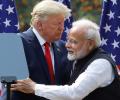
'Trump will absolutely back New Delhi on its position that Pakistan must do more to crack down on terrorists that threaten India.'
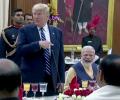
'Many said his visit was very risky. But mercifully, Air Force One has taken off from Delhi without Mr Trump stepping on anybody's toes,' notes Ambassador T P Sreenivasan.

Tuesday's talks between Modi and Trump are likely to send across a clear message of growing congruence of interests between India and the US on major geopolitical developments in the region and beyond, particularly when China has been expanding its military and economic clout.

'Trump's disregard for norms and institutions could prove very costly for America's social fabric.'

The EAM when asked about his view of the world at present, said it would be "very grim forecast, for the next five years".
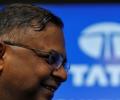
Chandrasekaran, who is the co-recipient of this year's USIBC Global Corporate Leadership Award, also said it is possible to have a limited deal between India and the US before the elections there in November if both sides work together to get something done and not try to solve all issues at once.

The Biden administration's failure in stopping two major wars and several minor ones was seen as a major disaster by many Americans and the world at large, observes Ambassador T P Sreenivasan.
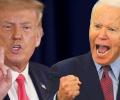
Irrespective of the outcome of Tuesday's keenly-contested US presidential election, America's strategic relationship with India is expected to maintain the current momentum and strengthen further, policy documents and remarks from the two campaigns indicate.

Ron Somers, founder and CEO of India First Group and the former President of leading business advocacy group US-India Business Council said that when Lok Sabha election results are declared on June 4, "I believe that Narendra Modi will win Parliament by the largest majority ever recorded in the country's history.
